 Sal, Cabo Verde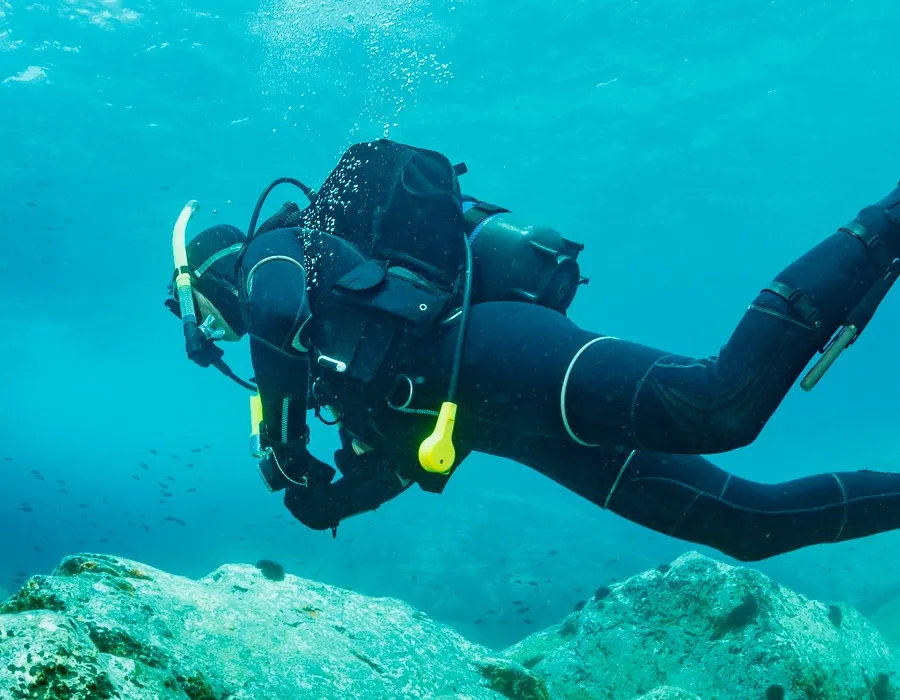
The PADI Open Water Diver certification is the world's most popular scuba qualification. Once you hold it, you can dive with a buddy to 18 m almost anywhere on the planet — and your card never expires. Getting certified in Cape Verde means training in warm Atlantic water with turtles, rays and wrecks as your classroom.
The main fear we hear is simple: "Will I spend half my holiday in a classroom?" You do not have to. This guide explains exactly how the PADI Open Water course works in Sal, how long it takes, what it costs, what should be included and how to arrive ready to spend your time in the water.
What the PADI Open Water course includes
The course has three parts. Knowledge development covers how pressure affects your body, equipment, planning and safety. Confined-water dives — five sessions in a pool or calm, shallow water — teach core skills such as clearing your mask, recovering your regulator and controlling buoyancy. Open-water dives — four dives in the ocean — let you practise those skills on a real reef.
When you finish, you are certified to dive to 18 m with a buddy, rent equipment and book dives anywhere in the world.
How long does it take?
Typically three to four days on the island. If you complete the theory through PADI eLearning before you travel, two to three days of in-water training are usually enough. Doing the reading at home is the single best way to protect your holiday time.
We schedule your training around wind and visibility, putting your first ocean dives on the calmest mornings of your stay — another reason to start the course early in your trip rather than on your last days.
How much does the PADI Open Water course cost in Cape Verde?
Prices vary between dive centres, so compare carefully. A fair comparison includes equipment rental, instructor time, boat dives, the PADI eLearning or manual and your certification card. Some operators quote a low price and add these later.
Our PADI Open Water course starts €420 all-inclusive. The only optional extra is a photo or video package of your dives.
Requirements: age, swimming and medical
The minimum age is 10 (10–14 year olds earn the Junior Open Water certification). You will need to swim 200 m without stopping — any stroke, no time limit — or 300 m with mask, fins and snorkel, and float or tread water for 10 minutes.
Every student completes the PADI medical questionnaire. If you answer yes to any condition, you will need a doctor's signature before in-water training. Send us the form before your trip so a missing signature never costs you a course day.
A typical course schedule in Sal
- Before you fly: complete PADI eLearning at home (we send the link when you book).
- Day 1: knowledge review, equipment set-up and confined-water skills in calm, shallow water.
- Day 2: remaining confined-water skills, then open-water dives 1 and 2 on a sheltered reef.
- Day 3: open-water dives 3 and 4, final skills — and your certification.
Nervous students are welcome. We keep groups small — never more than 6 guests per guide in the water — and move at the pace of the person who needs the most time.
Discover Scuba first, or straight into Open Water?
If you are not sure diving is for you, start with a Discover Scuba Diving experience. If you love it, the skills and the open-water dive can often be credited towards your Open Water course, so nothing is wasted.
After Open Water: what next?
Many divers continue with the PADI Advanced Open Water course on the same trip: five adventure dives including a deep dive to 30 m and navigation. Enriched Air (Nitrox) is another popular add-on that extends your bottom time on fun dives.
Why train in Cape Verde rather than at home?
Many people learn to dive in a cold lake or quarry at home, with thick wetsuits and limited visibility. Training in Sal means warm water, good visibility on calm days and real marine life from your very first open-water dive. Skills feel easier when you are relaxed and comfortable, and seeing a turtle on your second ocean dive is a powerful reason to keep going.
There is also a practical advantage: holiday time is focused time. Instead of spreading the course over several weekends, you complete it in a few consecutive days while every skill is fresh, which most students find makes them more confident divers.
What makes a good Open Water instructor?
The instructor matters more than the location or the price. Look for someone who keeps groups small, explains why each skill matters rather than just demonstrating it, and is willing to repeat a skill until you are genuinely comfortable. Ask how many students they teach at once, whether they speak your language fluently and how they handle students who struggle with a particular skill — mask clearing is the most common one.
At Bubble Blue, the instructor who answers your first message is usually the one who teaches you. That continuity is deliberate: by the time you arrive, they already know your goals, your worries and your schedule.
Common worries, honestly answered
"What if I can't clear my mask?" It is the skill most people find hardest, and almost everyone gets there with patience and practice in shallow water. "What if my ears hurt?" Equalise early and gently; descend slowly; stop and ascend a little if needed. "What if I panic?" You will learn exactly what to do, and your instructor will be close enough to help at every stage.
What to bring for your course
Bring swimwear, a towel, reef-safe sunscreen, a hat, your eLearning completion record and, if you have one, a signed medical form. We provide all scuba equipment, but many students like to bring their own well-fitting mask. A notebook helps for the knowledge review, and a positive attitude helps for everything else.
Get certified in Cape Verde
Certifying on holiday turns a week in the sun into a lifelong skill. Tell us your dates and whether you have started eLearning, and an instructor will build a schedule around the calmest days of your stay. Compare all courses on our PADI courses page.
Frequently asked questions
How many days is the PADI Open Water course?
Usually three to four days, or two to three in-water days if you complete PADI eLearning before you travel.
Is a PADI certificate from Cape Verde valid worldwide?
Yes. PADI certifications are recognised internationally and do not expire.